Ansible vs Chef vs Puppet: Which Tool Should You Standardize On?
All three configuration management tools can hold a fleet at a desired state. The differences that matter are operational: what your engineers must learn, what you have to babysit, and how quickly the first automation saves real time. Chef and Puppet install an agent on every node and pull from a central server you must patch, scale, and issue certificates for. Ansible pushes changes over SSH or WinRM with nothing installed on targets, and its YAML playbooks read like runbooks any engineer can review in a pull request.
| Criteria | Ansible | Chef | Puppet |
|---|
| Architecture | Agentless, push over SSH/WinRM | Agent pulls from Chef Infra Server | Agent pulls from Puppet Server |
| Language | YAML playbooks | Ruby DSL cookbooks | Puppet DSL manifests |
| Learning curve | Days for most teams | Steep without Ruby experience | Moderate; model-driven mindset |
| Infrastructure to run | None required | Chef server plus certificates | Puppet server plus certificates |
| Strongest fit | Mixed estates, orchestration, fast adoption | Ruby-fluent teams with mature cookbooks | Large static estates needing strict state enforcement |
Total cost of ownership follows the same pattern: Chef and Puppet servers need capacity planning, backups, and upgrade windows, and fleet-wide agent version skew becomes its own maintenance project. With Ansible, the moving parts are a Git repository and a control node your CI system already provides, and community collections cover modules teams would otherwise write themselves.
One honest caveat: years of working Chef cookbooks or Puppet modules carry real switching costs. We migrate such teams incrementally, one tier at a time, so coverage never drops. For teams starting fresh or running a mixed Linux and Windows estate, Ansible configuration management usually wins on operating overhead alone.
Playbook Patterns That Scale Past the First Hundred Servers
The playbook that configures ten servers rarely survives five hundred. What breaks is structure, not syntax. We build every Ansible configuration management engagement around a small set of patterns proven on large fleets: single-responsibility roles instead of thousand-line playbooks, versioned collections shared across teams, and a strict rule that any variable is defined in one predictable place rather than scattered across the nine precedence levels Ansible technically allows.
- Idempotency enforced in CI: every role runs twice in a container pipeline, and a second run that reports changes fails the build.
- Molecule tests and ansible-lint on every pull request, so a broken role never reaches your control node.
- block/rescue error handling with explicit failure states, instead of silent ignore_errors flags.
- Tag and --limit conventions that let engineers run one slice of automation without rereading the whole repository.
- Native modules over shell commands wherever one exists, because a module knows the current state and reports change honestly, while a raw command always claims it did something.
Structured this way, playbooks become infrastructure documentation your auditors and new hires can actually read. Our published results include 200+ engineering hours saved monthly — time that previously went to hand-patching and firefighting. The discipline also pairs naturally with our Infrastructure as Code solutions: Terraform provisions the machines, Ansible configures them, and both live in version control under the same review workflow.
Compliance-as-Code: Pass Audits Without the Screenshot Scramble
Most compliance evidence is still collected by hand: an engineer screenshots SSH settings on a sample of servers and hopes the rest match. Ansible replaces that with enforcement. We encode your control framework, whether CIS benchmarks, DISA STIG baselines, or the technical controls behind SOC 2 and HIPAA, into roles that both apply and verify each setting: password policy, audit logging, kernel parameters, patch levels, firewall rules.
Because every run is logged, each scheduled execution produces timestamped evidence that every host, not a sample, matched the baseline on that date. Drift is corrected automatically at the next run instead of being discovered during audit week. It is also how a hardening baseline survives a major move: run the same enforcement roles on old and new environments and compliance travels with the workload — the discipline behind our zero-downtime migration of a healthcare platform.
If your driver is a certification deadline, this pairs directly with our SOC 2 compliance automation service: Ansible handles technical control enforcement while the audit program tracks policies and evidence collection. Your auditors get machine-generated run logs; your engineers get their week back.
Designing Ansible Inventories for Large, Changing Fleets
Inventory design is where Ansible deployments quietly succeed or fail. A static hosts file works at 30 servers and lies to you at 300: the moment autoscaling, spot instances, or a second cloud region appears, a hand-maintained list is stale by definition. We design inventories that describe your fleet the way your business thinks about it, then let plugins keep them true.
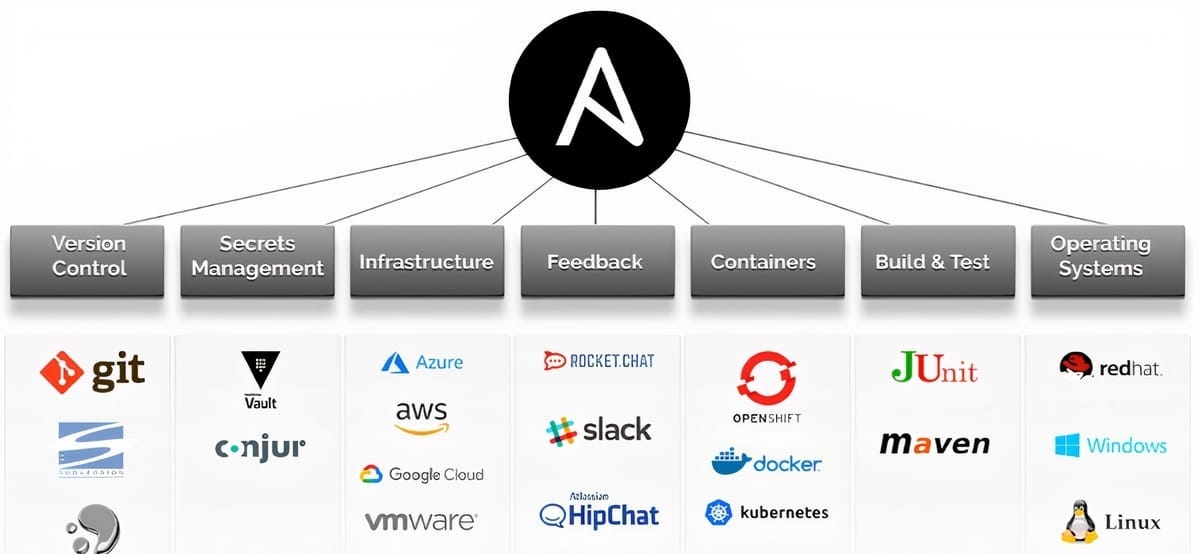
- Dynamic inventory plugins query AWS, Azure, GCP, or VMware at run time, so hosts are grouped by their tags the moment they exist.
- Group hierarchies model three axes: function (web, database, queue), environment (dev, staging, production), and location, so a play can target exactly "staging databases in us-east-1."
- group_vars carry defaults down the hierarchy; host_vars exist only for true exceptions, which keeps overrides auditable.
- Serial batches and --limit conventions cap blast radius, so a bad change touches five hosts, not five hundred.
Naming matters as much as tooling here. We establish group and variable naming conventions on day one, because an inventory that three teams can read without a translation meeting is what makes self-service automation possible later. Get this right and provisioning stops being a queue your teams wait in: one client reached 10x faster environment provisioning once provisioning was rebuilt as code, and the full story is in our environment provisioning case study.
What Agentless Architecture Actually Buys You
Every agent-based tool adds a daemon to every server you own: one more process to patch, one more credential store, one more CVE feed to watch, one more thing that can crash and silently stop reporting. Ansible's agentless model removes that entire class of work. It connects over SSH and WinRM, channels your security team has already hardened, and respects your existing bastion hosts, jump boxes, and IAM boundaries instead of inventing a parallel access path.
- New machines are manageable the second they boot, with no bootstrap or enrollment step.
- Devices that cannot run agents, such as switches, firewalls, load balancers, and appliances, are automated in the same playbook language as your servers.
- Short-lived cloud instances stop wasting minutes installing agents that die with them.
- There is no central management server to become a single point of failure or an attacker's highest-value target.
Agentless does mean each run opens connections from a control node, so we tune execution with forks, pipelining, and execution environments to keep large runs fast. If you are weighing Ansible against an agent-based incumbent, talk to our engineers; we will benchmark both against your actual fleet before you commit to either.